
Recently, I had to give a presentation to our board to share the plans for our new onboarding program. As I was preparing, I wanted to give leadership a comprehensive overview of what onboarding actually entails.
To do this, I included the onboarding framework in my presentation, to visualize the different onboarding elements, but also to use it as a blueprint once I started building the new onboarding program.
Today, I will share this onboarding framework with you. I will show you how to use it to audit and build an onboarding program for any organization.
Table of Contents
The Onboarding Framework
The onboarding framework that I designed is adapted from Talya Bauer’s established 6 C’s model – the elements being Compliance, Connection, Confidence, Clarity, Culture and Checkback. There are a few distinct differences in the way I set up the framework.
First, I adjusted some of the terminology to better resonate with a broader audience. Second, the framework is structured around five distinct pillars instead of six.

Furthermore, in contrast to the idea that every pillar serves as a stand-alone element, I found that culture permeates every other element.
It drives how an organization approaches legal adherence and policy communication, how role expectations are set, the way training and feedback are delivered, and how employees ultimately connect with one another.
Last, I left out the element Confidence in the onboarding framework, because confidence is an outcome that naturally develops when all the other elements of the program are balanced effectively. Having said that, let’s break down these core pillars and what they mean in practice.
Culture
Culture refers to how well new employees understand their new organization’s norms, values, stories, and symbols. Culture can be hard to pinpoint because it’s not something you can always see or describe easily.
It’s about the shared habits and values that shape how things are done in an organization. For new employees, understanding the culture helps them feel part of the team and organization.
Sharing culture through storytelling is essential because narratives are remembered up to 22 times better than cold data or bulleted slides. This allows new hires to naturally align their own behavior with the organization’s true norms.
Compliance
Compliance is the backbone of any onboarding process. It’s the set of must-do tasks every company needs to check off before a new hire can fully settle in. Think about things like getting documents signed, preparing IT equipment, assigning access badges, and setting up their workspace.
Even companies that claim to have no formal onboarding program are still obligated to meet these basic standards to make sure that the new hire is able to start.
Role Clarity
Starting a new job can feel like stepping into unfamiliar territory. For new employees, clarity is therefore essential. To achieve this, it is important that they understand their responsibilities and what success looks like.
Role clarity also means helping new hires see how their work contributes to the company’s mission, values, and culture. This creates a sense of purpose rather than just a set of functions to perform.
Understanding the team’s dynamics is equally important. Knowing who they report to, who their key collaborators are, and how communication works within the team can make a huge difference. When these elements are clear from the start, employees are more likely to succeed.
Training & Feedback
Starting a new role requires more than just knowing what to do; it requires developing the skills and knowledge to do it well. Training provides new employees with the tools, resources, and guidance they need to perform their role with confidence.
However, learning is a continuous process that relies heavily on effective feedback loops. Regular check-ins and constructive feedback ensure that new hires know how they are progressing, where they are excelling, and where they might need additional support.
By combining structured learning with consistent feedback, organizations create a safe environment for growth, allowing new employees to build competence, gain autonomy, and quickly reach full productivity.
Connection
Connection during onboarding is all about relationships in the workplace and refers to how accepted and valued new employees feel. And let’s be honest; nothing feels better than starting you first day at a new job with a personalized greeting and enthusiastic colleagues that are grateful for your arrival.
A meaningful conversation with a manager about important topics — such as professional dreams, passions, talents — can reassure someone that they are in the right place.
And moments of support and encouragement from teammates several months into a role can make all the difference in deciding to continue through challenging moments.
According to Forbes, quality working relationships help build a strong company culture that emphasizes respect, loyalty, and trust. Social connection creates a sense of cohesion in the office, which is important for developing creativity, teamwork, and collaboration.
Why Does an Onboarding Framework Matter
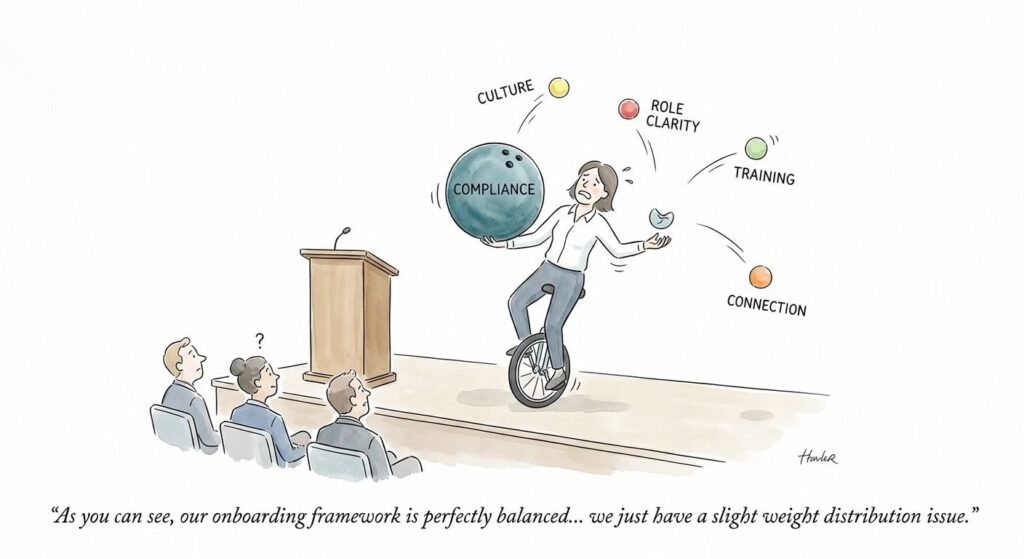
An onboarding framework matters because it serves as a guide. You might already have a solid program that touches on all the right elements, or you might only be incorporating one or two elements out of sheer necessity—like Compliance.
The problem is that – without a framework – you don’t know if you are incorporating all of the elements and if there is a balanced mix. The onboarding framework ensures you can confidently load your onboarding program with different elements, knowing that you are not overlooking anything.
Beyond a design roadmap, the framework also functions as a powerful diagnostic tool. If you are looking to elevate your current onboarding, you must first understand where you stand. Mapping your existing process against these pillars allows you to audit your program and identify immediate gaps.
Furthermore, it serves as a compelling visual when building a business case for management, clearly illustrating the strategic components required for success. Whether you are auditing your current state, pitching leadership, or mapping out a new design, this versatile tool guides you through every stage of the optimization journey.
The Onboarding Framework in Practice
Now that we’ve covered the five core pillars of a great onboarding framework, let’s look at how it actually works in the real world. To do this, I’ll show you exactly how I leveraged this framework to transform an onboarding program during one of my recent projects.
1. Securing Buy-In for the Business Proposal
During my tenure at a professional services firm, I quickly recognized the untapped potential in our onboarding process—alongside some major areas of improvement. New hires were eager, but the program left them feeling disconnected and overwhelmed.
I decided to change that and prepared to pitch a business proposal the board. The onboarding framework served as the anchor for my business proposal to management and the board. This is important, because stakeholders need to see the full scope of what an onboarding program entails.
By structuring the proposal around the framework, I helped leadership instantly visualize exactly which elements were critical and what specific role they played in the onboarding journey. It also helped them to see onboarding as a strategic tool for retention and performance. Ultimately, this helped me get the green light to deliver the new onboarding program.
2. Using the Onboarding Framework as a Diagnostic Tool
A pitch without data is just an opinion. Before presenting to the executives, I needed an objective overview of our current state, and the onboarding framework proved to be the perfect lens.
I mapped every existing onboarding activity and contact point into the framework’s five pillars. The diagnostic result was stark: our process was heavily weighted toward Compliance (paperwork and IT setup), while Role Clarification was vague, and Culture was almost entirely non-existent.
Fortunately new hires did feel a Connection to our firm quickly, that was one of the strong points. By using the framework as an audit tool, I didn’t just tell the board our onboarding was falling short; I showed them the exact, structural gaps we needed to bridge. The project was instantly approved.
3. Turning the Onboarding Framework Into a Design Roadmap
With the board’s green light, the onboarding framework shifted from a diagnostic tool into our architectural blueprint. I was eager to design a deliberate journey from Day 1 to Day 90.
Using the five pillars as the design roadmap, I systematically built out the missing pieces:
- We kept the mandatory Compliance but streamlined it so it didn’t consume the first week.
- We designed a “Culture Track” to explicitly introduce company values, rather than hoping new hires would just pick them up by osmosis.
- We mandated a 30-60-90 day goal-setting template to guarantee Role Clarification and an overview of all the Trainings new hires needed to follow.
- We set up pulse- surveys (Feedback) which were distributed after the first week, halfway down the onboarding and at the end of the program to measure new hire’s experiences.
- We incorporated structured evaluation sessions – once right before the probation period ended and once at the end of the onboarding program – in order to give and receive structured Feedback.
By aligning our design directly with the framework, we ensured that the new onboarding program was balanced, holistic, and sound right from the start.

4. Ensuring Alignment During Implementation
Building a program on paper is one thing; rolling it out to busy managers and diverse departments is another. During the implementation phase, we used the framework as a continuous reference tool to ensure that every single element was successfully incorporated and maintained.
To make this practical, I applied color codes to our master overview of the program, assigning a distinct color to each of the pillars. This gave us an instant, visual health check of the entire initiative.
The visual matrix also allowed us to map and balance the onboarding experience across a realistic timeline (from Week 1 to Month 1 and Month 3). Naturally, the color balance shifts as a new hire progresses. Here are some examples of what that looks like.
- Week 1 typically looks dense with Compliance and Connection as employees fill out mandatory documentation and get to know new colleagues.
- Month 1 typically involves a lot of (on-the-job) training to learn how to work with the necessary systems and tools.
- Months 2 and 3 naturally transition toward Role Clarity & Feedback and a deeper immersion into company Culture.
By visualizing this progression, we ensured that onboarding didn’t abruptly stop after the first week, but instead evolved into a sustained, structured journey.
5. Closing the Loop with Pulse Surveys
Last, the onboarding framework serves as the perfect tool when reviewing feedback from new hire pulse surveys. When employees share their onboarding experiences at critical milestones, their pain points can be instantly mapped back to the pillars.
Conclusion
An effective onboarding program serves as a strategic blueprint for long-term retention, engagement, and performance.
By moving away from an ad-hoc approach and anchoring your strategy in a structured, five-pillar onboarding framework, you ensure that Culture, Compliance, Role Clarity, Training & Feedback, and Connection work in harmony rather than competing for attention.
Whether you are using this framework to diagnose the hidden gaps in your current process, pitch an upgrade to leadership, or map out a 90-day roadmap for new hires, it serves as your architectural compass.
Don’t let your onboarding process accidentally turn into a one-sided juggling act. Balance the scales, load your program intentionally, and give your new hires the foundation they need to thrive.