
When you search for popular onboarding topics, one keyword appears again and again: onboarding checklist. And honestly, that makes sense.
For HR professionals, managers, and growing teams, a checklist feels practical. It creates structure, reduces uncertainty, and helps people feel like the process is under control.
But there’s an important distinction many organizations miss: A checklist can support onboarding, but it cannot define the onboarding experience.
That doesn’t mean checklists are bad. Far from it. A strong onboarding checklist is incredibly useful. The problem starts when companies treat the checklist as the strategy instead of the tool that supports it.
Table of Contents
Why People Rely on Onboarding Checklists
There’s a reason why onboarding checklists are so popular. They bring clarity. When onboarding involves HR, IT, managers, finance, and team leads, things can easily fall through the cracks. A checklist helps teams coordinate, stay aligned, and avoid preventable mistakes.
It also makes onboarding easier to repeat and scale, especially in fast-growing companies. And to be fair, operational details matter. New hires notice when their laptop is missing, when nobody knows their schedule, or when access requests are delayed.
Those moments shape first impressions faster than most organizations realize. But logistics alone do not create a great onboarding experience.
Why You Shouldn’t Start with the Checklist
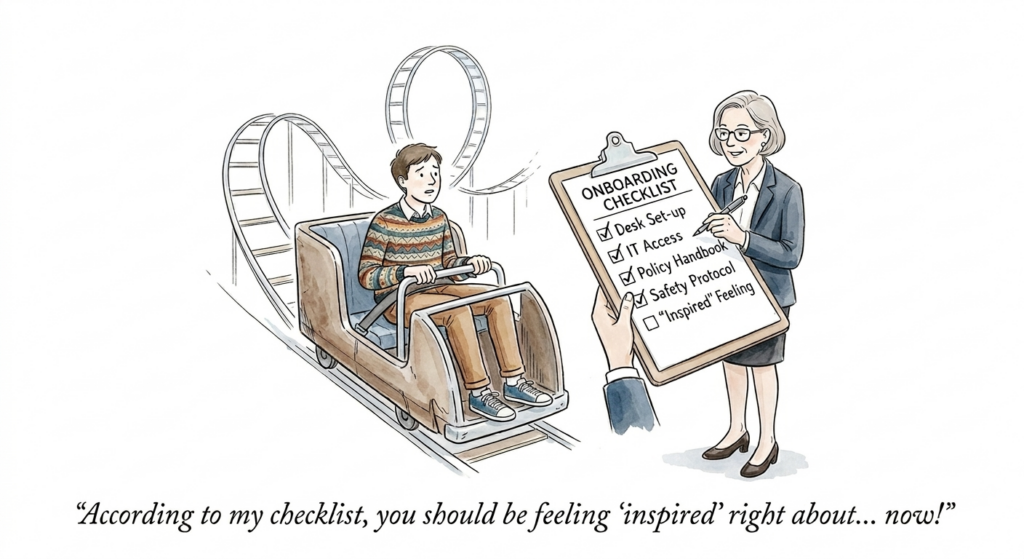
A checklist is not the starting point of good onboarding. It’s the result of a well-designed onboarding strategy. When companies start with the checklist itself, onboarding often turns into a disconnected sequence of tasks: set up the laptop, schedule a meeting, send the handbook, complete compliance training.
Necessary? Absolutely. Memorable or effective? Not really. Great onboarding starts somewhere else. It starts with questions, such as:
- Culture Tangibility: Beyond reading the mission statement, what is one specific ritual or “unwritten rule” a new hire should witness or participate in during their first week(s)?
- Cross-Functional Connection: Which three people outside of the new hire’s immediate team are most critical to their success, and how will we facilitate an introduction?
- Emotional Journey: How do we want the new hire to feel at the end of their first day? (e.g., Relieved? Inspired? Challenged?)
- Knowledge Transfer: What is the “tribal knowledge” (information not in the handbook) that usually takes people months to learn, and how can we share it sooner?
- Autonomy vs. Structure: Does our company value following a set path, or do we expect the hire to define their own way? How does the checklist reflect that?
Keep in mind that some of these questions are best answered by hiring managers or other stakeholders in the organization. It is therefore key to use their input.
Once those questions are clear, the checklist becomes far more useful because every task supports a larger outcome.That’s the difference between managing onboarding and designing onboarding.
A Better Way to Design an Onboarding Checklist
Now you know that a checklist plays an important role. It just shouldn’t carry the entire onboarding experience on its shoulders.
Think of it like designing a house. You don’t start with a list that says “install windows†or “paint walls.†You start with the foundation. With onboarding, the checklist comes later, once you know what you’re actually trying to design.
Design onboarding from the inside out
Instead of downloading a generic template and forcing it into your company, it’s more effective to design onboarding from the inside out. Start with the purpose. Why does onboarding matter in your organization? What should it help employees achieve?
Then define the outcomes. What should new hires know, feel, and be able to do after their first few weeks and months?
From there, map the journey itself. What should happen before day one? What matters most during the first week? What support should exist after the initial excitement wears off?
Only after those decisions are clear should the checklist come into the picture. At that stage, the checklist becomes much more valuable because it reflects your company, your culture, and your expectations instead of someone else’s template.
Tailor the onboarding checklist to your organizations’ context
One of the biggest misconceptions is that there’s a single onboarding checklist every company can use. In reality, onboarding is deeply contextual.
A startup with 20 employees does not onboard the same way as a global enterprise. Remote teams operate differently from office-based teams. Some roles require long ramp-up periods while others expect immediate output.
Even within the same organization, onboarding for a sales hire will likely look very different from onboarding for an engineering leader.
Culture also changes the experience more than people think. A company that values autonomy may intentionally keep onboarding flexible and lightweight. Another organization may prioritize structure, documentation, and formal milestones. Neither approach is wrong, but both require very different onboarding experiences.
That’s why generic templates often don’t feel complete. They can help with organization, but they rarely reflect the full reality of how a company actually works. And most onboarding problems are not caused by missing tasks anyway. They’re usually caused by missing clarity.
Think about unclear expectations. Managers who are too busy to prepare. Or teams that assume someone else owns the process. A checklist cannot solve those issues on its own.
Choose the Right Information Platform
Another critical decision to make before drafting your checklist is where you will display your onboarding information.
Whether your company chooses a dedicated onboarding app to provide an interactive journey, utilizes an intranet for centralized resources, or relies on an HRIS to house handbooks and mission statements, the platform itself shapes the experience.
For example, your handbook might sit on the intranet, while an explanation about role‑specific responsibilities are captured as a Notion to‑do item, and formal documents are stored in the HRIS.
Defining this early ensures that items on the checklist are displayed in the right system. Choose the platform setup that aligns with your company’s workflow so you can place each resource where it belongs and build a checklist that really supports the experience.
Why the Right Onboarding Checklist Still Matters
Even though a checklist should not drive the strategy, having the right one can still save you a huge amount of time and energy. A well-designed onboarding checklist creates alignment, consistence and clarity.
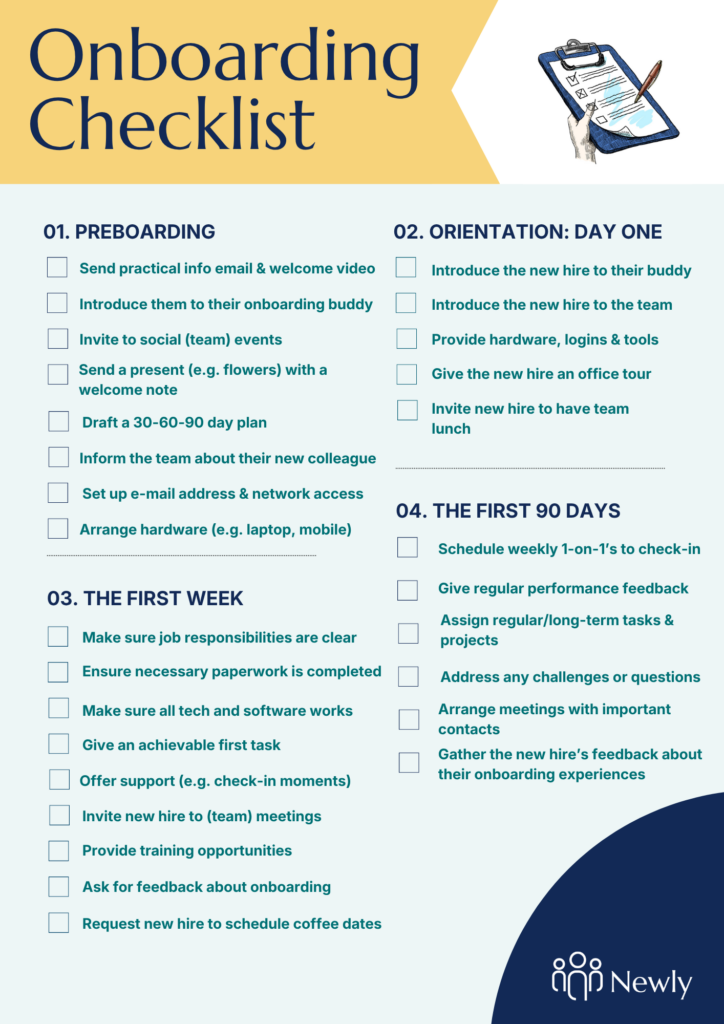
Also, a decent downloadable template gives you a strong starting point, as it covers many of the operational basics and helps you to move faster.
But no template is truly plug-and-play. Every company still needs to adapt it to their own culture, industry, and ways of working. That’s why the best onboarding checklists are customised to fit those realities.
And last, the structure of a template is useful, but the real difference comes from how the checklist is applied in practice.
Conclusion
An onboarding checklist is valuable, but only when it supports a larger onboarding strategy. The best onboarding experiences are designed to help new hires build confidence, understand expectations, and connect with their peers. Here are the key takeaways:
- Why we rely on checklists: They simplify the complexity of coordinating between HR, IT, and managers, ensuring nothing falls through the cracks.
- Why the right checklist matters: It provides the necessary structure and consistency to ensure every new hire receives a high-quality, professional welcome.
- Why not to start with the checklist: When onboarding lacks a strategic foundation, elements like cultural alignment and role clarity fall through the cracks, making the new hire feel like a box to check instead of someone you’re genuinely investing in.
- Why universal lists fail: Every company culture and industry is unique; a generic template must be customized to fit your specific roles, values and industry specific standards.
By using my downloadable onboarding checklist as a foundation and following the attached instruction guide, you can customise it with your company’s unique “blueprint”. By doing so, you will create an onboarding process that is operationally sound and aligned to your broader (onboarding) goals.