
When designing a well-rounded onboarding program, one question invariably surfaces: How do we actually integrate company culture? It’s a challenge that is far easier said than done.
During a recent onboarding project, I worked with a company that possessed a vibrant, unique culture. However, it wasn’t documented anywhere, let alone woven into their orientation day or broader onboarding process.
Tasked with bridging this gap, I dived into the research to find a solution.
Today, I’m sharing those insights with you. First, we will look at Edgar Schein’s famous culture model. Then, I will share five practical, real-world approaches to immediately inject your company’s culture into your own onboarding program. Let’s get started.
Content
The 3 Levels of Organizational Culture
Professor Edgar Schein was an organizational psychologist and a pioneer in the field of organizational development. He introduced the idea that corporate culture consists of layers, much like an iceberg. Only a small portion is visible above the surface, while the larger, more impactful elements lie hidden below.
1. Artifacts – Above the Surface
Artifacts occupy the peak of this iceberg, the visible portion resting above the surface of the water. They represent the immediate look, feel, and buzz of the space when you walk into an organization.
They are the tangible, overt expressions of a company’s environment. Key elements include:
- Physical Architecture & Layout: Open-plan collaborative spaces versus enclosed private offices, lighting, decor such as paint(ing)s and carpets.
- Dress Codes & Branding: Formal corporate suits versus casual startup attire, as well as company logos and visual aesthetics.
- Language & Communication Style: The use of specialized jargon, acronyms, corporate humor, and the tone used in meetings or emails.
- Rituals & Ceremonies: How success is celebrated, how onboarding is conducted, and how the organization handles departures.
- Published Materials: Official employee handbooks, annual reports, policies, and marketing materials.
Artifacts are highly accessible and the easiest layer to observe, Schein cautioned that they are notoriously difficult to interpret accurately on their own. Because they exist on the surface, artifacts are easy for leaders to manipulate.
For example, a company might install a ping-pong table and publish a dress code (surface artifacts), while maintaining a micromanaged work environment underneath.

2. Espoused Values – Just Below the Surface
Espoused values are the stated principles, beliefs, and standards that a company officially claims to follow. They act as the company’s public-facing approach and are meant to guide how employees make decisions, set goals, and interact with one another. You typically find them in:
- Company Statements: Core values, mission, and vision statements.
- Official Handbooks: Rules of conduct, ethical guidelines, and compliance policies.
- Internal Messaging: Leadership speeches, company slogans, and internal campaigns.
- Public Commitments: Announced initiatives, like sustainability goals or diversity and inclusion programs.
When a company faces a crisis or an unpredictable challenge, leaders point to these stated principles to tell employees exactly how they are expected to handle the situation.
The Reality Gap: What We Say vs. What We Do
A major focus of Schein’s work is the frequent disconnect between what a company proclaims to believe and how it actually functions. This highlights the big difference between “espoused theory” (the ideals we talk about) and “theory-in-use” (the rules we actually live by based on our daily behavior).
This gap usually happens for two reasons:
- Aspirational Thinking: Sometimes, stated values are just a wishlist. They represent what leadership wants the company to be, not what it actually is today. Until these values are backed up by everyday actions and accountability, they remain just words on a wall.
- Conflicting Rewards: People do what they are rewarded for doing, not what the handbook says. For example, a company might heavily promote “teamwork” as a core value. But if bonuses and promotions are only given to individual top performers who work alone, the actual value in use is solo achievement, not collaboration.

Mastering the Onboarding Framework: A Guide
Culture is just one piece of the puzzle. Learn how to weave it into the other four essential elements of onboarding to create a seamless experience from day one.
3. Basic Underlying Assumptions – Deep Below the Surface
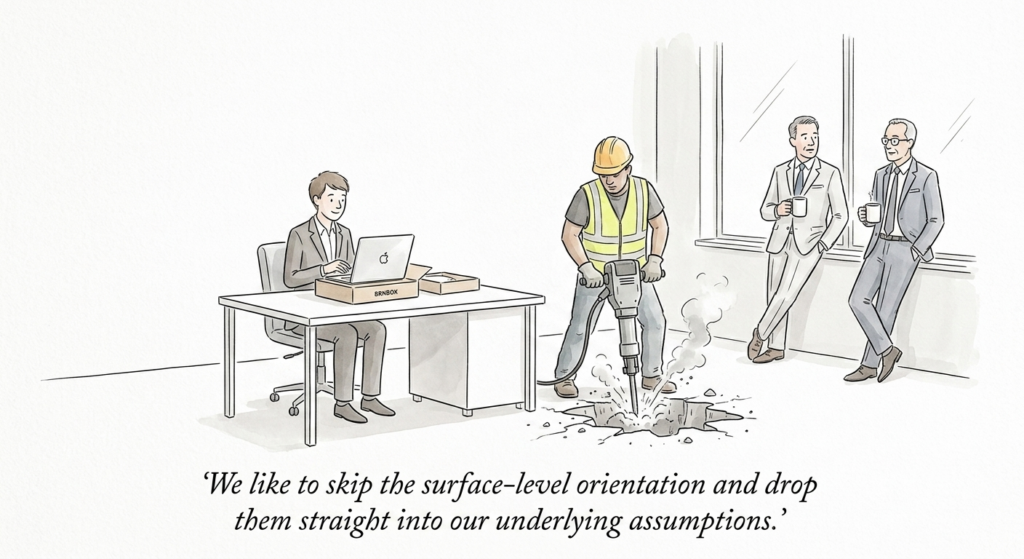
At the absolute bottom of the cultural iceberg, hidden deep below the surface, lies the foundation: Basic Underlying Assumptions. If artifacts are what an organization does and espoused values are what it says, underlying assumptions are what its people unconsciously believe.
These are the unconscious, taken-for-granted beliefs, perceptions, and thoughts that truly drive how people behave. They are the invisible, unwritten rules that dictate “how things actually work around here.” They typically are:
- Invisible and Unquestioned: They operate automatically in the background. Employees don’t debate them; they simply accept them as absolute truth.
- Born from Past Success: They develop over time because a certain way of thinking worked in the past. If a specific behavior repeatedly helps the company survive or win, it eventually hardens into an automatic assumption.
- Deeply Rooted: Because they are so ingrained, they are incredibly resistant to change.
These assumptions completely shape how employees interpret leadership decisions, handle conflicts, and prioritize their daily work. For instance:
- “Mistakes mean failure, so they must be hidden at all costs.”
- “If we take care of the customer first, the revenue and business metrics will naturally follow.”
- “None of us is as smart as all of us; we achieve our best results when we actively seek out diverse perspectives”
The True Lever of Cultural Change
This deepest layer explains why so many corporate culture transformations fail. When a company changes its surface-level perks (artifacts) or updates its mission statement (espoused values), it does not automatically change the way people think.
If the new values contradict the old, deeply rooted assumptions, the assumptions will always win. Schein argued that true, lasting cultural change only happens when leaders dig deep enough to identify these hidden beliefs, challenge them openly, and replace them with a new set of shared experiences that prove a different approach works better.
5 Ways to Infuse Culture in Onboarding
Now that we’ve covered the three layers of organizational culture, lets explore how we can infuse culture in onboarding through several methods. The following five practical approaches demonstrate how to bridge these layers, guiding new hires from surface-level awareness straight down to the firm’s deepest underlying assumptions.
| Approach | Explanation |
|---|---|
| 1. Apply behavioral Anchoring | Link core values ​​– such as ‘outspoken’ or ‘committed’ – to concrete, role-specific behavior that is visible and directly applicable. |
| 2. Employ context-specific practical scenario’s | Use realistic dilemmas from daily practice that are discussed interactively during onboarding. |
| 3. Link culture and values to work processes | Embed culture directly in processes, for example by discussing the values ​​during the 30/60/90 feedback sessions and performance appraisals. |
| 4. Use role models and storytelling | Let leaders share personal, authentic real-world stories about how the core values ​​helped them with complex client choices, for example through video’s, written narratives, or shadowing programs. |
| 5. Use the buddy as a carrier of culture | A buddy acts as an informal guide who passes down a culture’s unwritten rules through casual, daily interactions. They show newcomers how things actually work. |
1. Apply behavioral Anchoring
Behavioral anchoring is all about removing the guesswork from corporate values. Often, companies roll out grand words like “outspoken” or “engaged”, but leave it up to individual interpretation.
Behavioral anchoring solves this by translating those abstract concepts into concrete, role-specific actions that you can actually see and measure. Instead of relying on vague categories, it describes exactly what performance looks like through observable actions and decision-making quality.
For example, instead of just telling a junior lawyer to be “engaged,” an organization anchors this value with clear, explicit behaviors:
- “Proactively updates clients on case progress before they ask.”
- “Actively contributes at least one perspective during team strategy meetings.”
By establishing these explicit, observable standards, the organization builds a shared vocabulary where everyone knows exactly what is expected of them. This ultimately makes performance evaluations fairer and professional growth much more structured.
Applicable Layers: Artefacts and Shared Values
How it applies: Behavioral anchoring takes your abstract corporate values (Shared Values) and explicitly translates them into observable, measurable actions, habits, and language (Artefacts). It bridges the gap between what the company says it values and what you can actually see people doing on a daily basis.
2. Employ Context Specific Practice Scenario’s
No one truly learns an organizational culture by reading a dry list of rules in an employee handbook. Culture is alive, and it is most visible when people have to make tough choices. This approach focuses on using realistic, day-to-day dilemmas during onboarding to spark interactive discussions. Instead of lecturing new hires on compliance, teams gather to debate real-world grey areas.
Research on experiential training and scenario-based learning shows that immersing learners in real-life problem-solving situations bridges the gap between theoretical concepts and practical application. Teams work through realistic dilemmas such as:
- How to handle a conflicting or unrealistic client timeline.
- What to do when a core organizational value directly clashes with a tight deadline.
By practicing with these complex scenarios together in a low-risk environment, new team members quickly learn how the firm’s values guide actual business decisions.
Applicable Layers: Shared Values and Basic Assumptions
How it applies: When new hires debate real-world dilemmas (like a deadline clashing with a core value), they are looking past surface-level rules. They are learning how the company’s stated principles (Shared Values) interact with the deepest, unconscious layer of culture (Basic Assumptions)—the underlying priorities that dictate how the firm actually makes tough choices under pressure.
3. Link Culture and Values to Work Processes
For culture to stick, it cannot exist separate from daily operations; it must be hardwired into the infrastructure of the company. This method is about structurally anchoring values directly into established corporate processes, such as:
- 30/60/90-day feedback cycles: Instead of evaluating new hires purely on technical milestones, managers use these early checkpoints to review how closely the employee’s behaviors align with the company’s core values during their crucial first three months.
- Performance evaluations: Mid-year and annual evaluations are calibrated so that a specific percentage of an employee’s score depends entirely on how they achieved their goals
- Promotion & Advancement Criteria: To ensure long-term cultural fit, career progression is designed so that you cannot move into a senior or leadership role without consistently proving that you live the company’s values in your daily work.
Technology companies like Google and HubSpot build peer-review loops directly into their promotion tracks, explicitly asking colleagues to grade how well a candidate demonstrates core values like empathy, transparency, and humility before they can advance to a leadership position.
When an organization explicitly builds cultural alignment into its formal evaluation checkpoints, it sends a powerful message: how you achieve your results matters just as much as the results themselves.
Applicable Layers: Artefacts and Shared Values
How it applies: The formal evaluation systems, 30/60/90-day review cycles, and documented peer-review loops are structural, tangible systems (Artefacts). However, because these systems are explicitly designed to measure and reward how well an employee lives out the corporate principles, they serve as the operational enforcement of the company’s Shared Values.
4. Use Role Models for Storytelling
Human beings are wired for stories, not spreadsheets. This method leverages the power of narrative by having partners and senior leaders share personal, authentic case stories during introduction days, complemented by internal video series featuring colleagues.
When leadership opens up about real moments where they struggled, failed, or succeeded by relying on the firm’s core values, it creates emotional resonance. In organizational psychology, storytelling is recognized as one of the fastest ways to infuse culture.
It provides newcomers with visible “cultural heroes” and practical blueprints of how seasoned professionals navigate complex, high-stakes situations using the organization’s ethical compass.
Applicable Layers: Artefacts and Basic Assumptions
How it applies: The stories themselves, introduction days, and internal video series are visible, audible cultural outputs (Artefacts). However, the content of those stories—leaders sharing how they navigated high-stakes failures or ethical crossroads—acts as a window into the firm’s deep Basic Assumptions, giving newcomers a practical blueprint of the company’s true DNA.
5. Use The Buddy as a Carrier for Culture
Every organization has a formal culture (what is written down) and an informal culture (how things actually get done). This final method bridges that gap by structurally pairing new hires with a “buddy” who is equipped with a targeted conversation guide.
While formal training covers the official processes, the buddy is there to pass down the unwritten rules, social dynamics, and the “typical” way of working that you can’t find in a manual. Socialization research confirms that peer-to-peer mentoring drastically accelerates onboarding.
A buddy acts as a safe, informal cultural translator, helping newcomers comfortably integrate into the social fabric of the firm and adopt its core habits naturally.
Applicable Layer: Basic Assumptions (and how they drive casual Artefacts)
How it applies: While a buddy is a tangible person you interact with (Artefacts), their core purpose is to pass down the “unwritten rules” and informal social dynamics. By teaching the new hire how things actually get done behind the scenes, the buddy acts as a direct translator for the organization’s deepest, subconscious Basic Assumptions.
Implications for Leadership
Research on Schein’s framework emphasizes that values only become real when leaders “walk the talk.” When management consistently acts in alignment with their stated values, it builds trust and helps new hires easily adopt the culture.
However, when there is a major gap between words and actions, it creates cynicism, breaks trust, and reveals a deep fracture in the organization’s culture.
Shaping an authentic culture means executives must look beyond surface-level fixes. True alignment requires leadership to actively drive change through three critical actions:
- Uncover Deep-Seated Beliefs: Leaders need to investigate the subconscious mindsets of the organization by using active listening, field observations, and structured cultural assessments.
- Embed Values into Daily Operations: Management must explicitly bridge the gap between spoken principles and day-to-day actions, cementing them directly into corporate infrastructure, rewards programs, and team traditions.
- Set a New Standard: Changing the status quo requires leaders to personify new cultural expectations through their own choices, while celebrating team members who constructively challenge outdated habits.
Ultimately, genuine transformation isn’t about drafting a better corporate vision statement. It requires reshaping the foundational, unwritten assumptions that guide employee decisions when no one is supervising them.
Conclusion
Bringing a new team member on board is the single best opportunity an organization has to infuse and reinforce its company culture.
As Edgar Schein’s culture model reminds us, real culture isn’t found in a beautifully worded mission statement or a trendy office layout. Instead, it lives in the unspoken assumptions and unwritten rules that dictate how people behave when no one is watching.
By moving away from superficial orientations and adopting cultural integration approaches like behavioral anchoring, scenario practice, and buddies that share unwritten rules and how things are done, you bridge the gap between what your company says it values and how it actually operates.
Ultimately, this alignment ensures long-term commitment, trust, and collective success from the very start.