
Every now and then, I find myself talking to managers who are struggling with a new hire. They notice things aren’t quite clicking yet: someone isn’t performing at the level they hoped for, is still finding their way around the systems, or just doesn’t feel at home in the team.
I often see the same patterns emerge that explain why a new colleague sometimes has trouble settling in. But, I wanted to look beyond the surface. What are the psychological principles that determine whether someone moves through onboarding successfully?
So I dove into the research. And today, I want to share exactly what I found, and how it can change how you onboard your next hire.
Table of Contents
Why onboarding works or fails in the first days
Great onboarding works because it respects the underlying architecture of human psychology and neurology. It recognizes that starting a new job is a major disruption to a person’s daily routines. For the human brain, entering an unfamiliar environment naturally triggers a survival-driven stress response.
Because the brain’s primary job is to keep us safe, it constantly scans the new environment for threats. If it finds clarity and support, it unlocks the chemicals needed for focus and excitement. But if it senses confusion and isolation, it automatically triggers a fight-or-flight response, forcing the new hire to pull back to protect themselves.
Without a real safety net—like clear directions, easy access to the right tools, and welcoming colleagues—the brain flags the environment as unsafe. Left in isolation, a new hire quickly loses their initial enthusiasm and switches into self-defense mode, doubting their choice before they’ve even properly started.
Research on the neuroscience of human behavior confirms that our brains are fundamentally hardwired to resist change. When a person changes jobs, their established neural routines (the automatic habits that save mental energy) are severely interrupted. When employers fail to take this into account, the onboarding process quickly derails.
5 Reasons Why Your New Hire is Struggling
Creating a great onboarding experience means designing for the human brain. To do that, we have to look at how new hires process uncertainty and stress. Here are five neuroscientific reasons why new hires lose traction in their first days.
Reason 1: Uncertainty triggers the brain to scan for threat
When an individual enters a brand-new environment, their brain naturally craves predictability. Hidden deep inside the cerebrum is a small, almond-shaped structure called the amygdala, which regulates our automatic response to danger. Its role is to constantly scan for perceived threats and trigger immediate emotional responses—like fight, flight, freeze, or appease—completely outside of our conscious awareness.
During onboarding, the amygdala does this by comparing the new workplace against familiar routines, looking for deviations. When a person joins a company, almost everything is a deviation: the office layout, communication styles, and unwritten social rules.
From an evolutionary standpoint, the brain flags these differences because unpredictable equals dangerous. Until a new hire gathers enough positive data points to realize these differences aren’t threats, the amygdala stays in a heightened state of alertness.
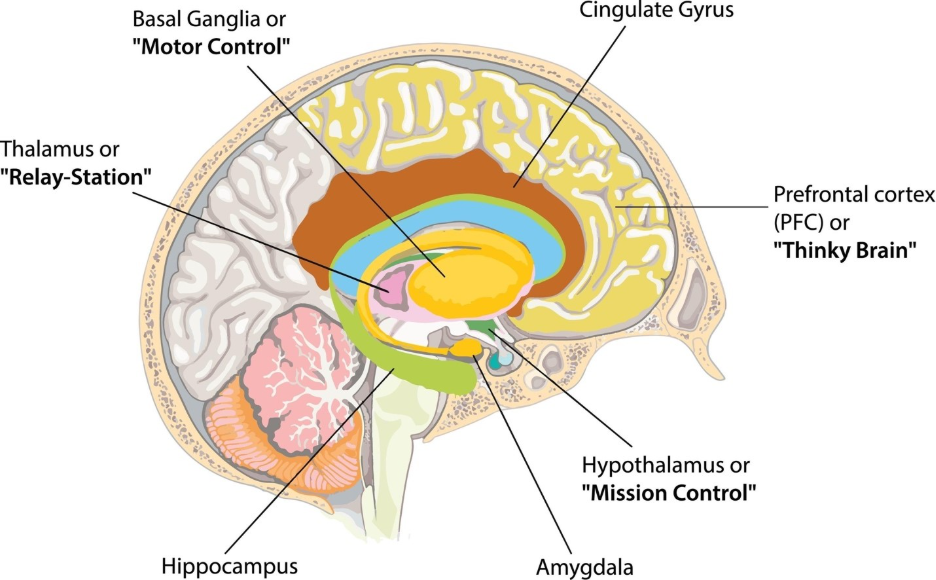
Unclear roles, vague priorities, and social unknowns raise stress levels because the brain naturally treats these corporate ambiguities as threats to its security.
Think about a new hire who has not been clued into the unwritten team norms. They don’t know if it’s acceptable to message a manager directly or wait for a scheduled meeting. Because the amygdala treats social pain and rejection exactly like physical pain, this social uncertainty actively degrades performance. 
Neurological studies show that exposure to rejection and social anxiety can cause an immediate 30% drop in reasoning and a 25% drop in functional IQ. This means that a new hire spends critical energy scanning for threats rather than executing tasks.
Reason 2: Information overload shuts down learning
There is a hard ceiling on how much new data the human brain can process at once, especially when it is on high alert. When we pack an orientation day full of back-to-back presentations, the brain gets flooded and triggers an immediate defensive reaction that blocks learning entirely. Trying to remember critical details during this kind of overload is almost impossible.
To process information logically, the brain relies on the prefrontal cortex—the region responsible for rational thinking. However, when a new hire is stressed or overwhelmed, it takes about 300 milliseconds for messages to travel from the emotional, reactive parts of the brain to this rational area. Think of that 300-millisecond delay as the brain’s internal buffering time. Whenever something happens, the information splits down two different tracks:
- The Fast Track (The Emotional Brain): This path is lightning fast. It instantly reacts to things based on survival, fear, or stress. It doesn’t think; it just feels and reacts.
- The Slow Track (The Rational Brain): This path goes to the prefrontal cortex, which thinks logically, solves problems, and learns new information. Because it is more complex, it takes about 300 milliseconds longer for information to get there and turn into clear logic.
Inside the New Hire’s Mind
Imagine a new hire is sitting in a meeting room, already a bit nervous. A presenter pulls up a massive, confusing spreadsheet and says, “We need you to master this by Friday.” At 0 milliseconds, the emotional brain instantly reacts: “Oh no, this is too much, I’m going to look stupid.” During the next 300 milliseconds, the brain tries to send that data over to the rational side so the person can calm down and actually start learning.
How Data Dumping Jams the Brain
If we continuously bomb a new hire with data, we jam that tiny 300-millisecond window. The presenter keeps talking at top speed, pouring more data, acronyms, and rules into that space before the rational side gets the quiet moment it needs to take over. The new hire stays stuck in that initial stressed, emotional reaction, which literally blocks them from absorbing anything else being said.
To avoid this mental traffic jam, onboarding needs to include natural pauses. Pacing the content, using repetition, and breaking information into bite-sized pieces gives the brain time to clear the lag and think clearly. Therefore, new hires will remember details much better if you share them slowly over time.
Reason 3: Belonging changes how fast people ask for help
The “need to belong” is a fundamental human motivation hardwired into our biology, exactly like hunger or thirst. Historically, separation from the tribe meant physical danger, which is why the brain still treats social isolation as a major survival threat. Because of this biological need, psychological safety dictates how fast a new hire will speak up, ask for help, and self-correct.
When entering an unfamiliar workplace, the brain’s threat detector—the amygdala—naturally triggers a defensive response, treating a new team as a potential social risk. Because this survival response makes us hyper-aware of judgment, new hires worry that asking a simple question will make them look incompetent.
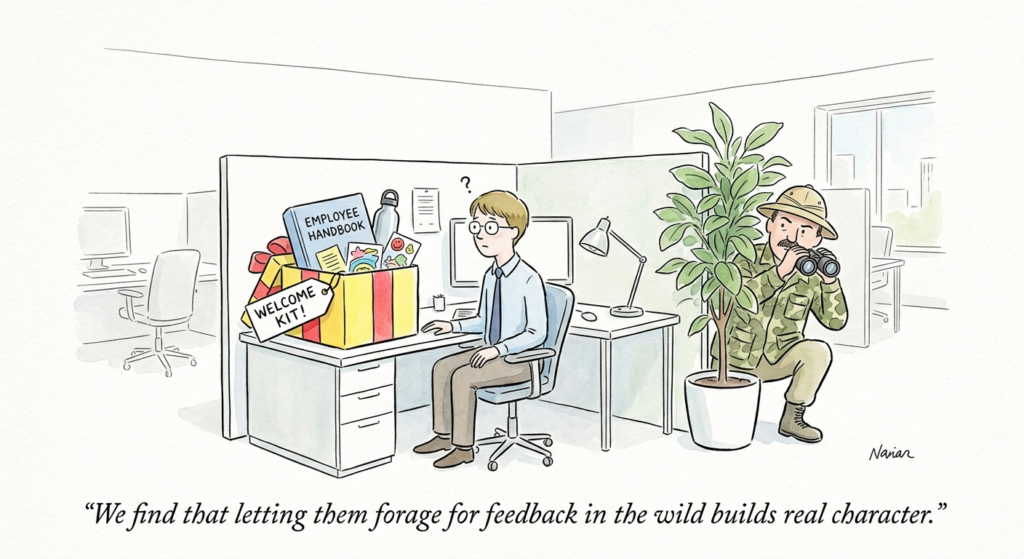
When this sense of belonging is low, you will observe clear signs of self-protection: silence, hesitation to point out an error, and constant second-guessing. A new hire might spend two hours struggling with a problem they could solve in two minutes with a quick question, simply because they don’t feel safe enough to ask.
Building this safety is a concrete, operational task. It depends on manager involvement, explicit team rituals, and structured early introductions. When a team intentionally signals that a new hire is welcome, it bypasses the amygdala’s defense mechanism.
The moment that survival alarm shuts down, the psychological barrier drops, and the new hire instantly feels safe enough to ask for help without fear of judgment.
Reason 4: Lack of early wins create a dopamine drop
Small, tangible victories trigger a release of dopamine, the brain’s natural reward chemical, which instantly reinforces a new hire’s motivation and sustains their effort. When a new hire achieves a small success, the hit of dopamine tells the brain, “That went well, let’s do it again,” physically driving them to seek out the next challenge. Because of how the brain creates this forward drive, visible, measurable progress on day one matters far more than big promises about the company’s long-term future.
Because of this, initial assignments should be designed as clear, immediately useful tasks that can be finished in a single sitting. Completing a small, real-world task on the very first day builds immediate momentum, transforming neurological anxiety into a sense of practical competence.
When a company structures the first week around these achievable, bitesize milestones, they are systematically training the new hire’s brain to associate their new environment with confidence and success.
Reason 5: Culture is presented as a poster
The preference for narrative is hardwired into our evolutionary biology. Cognitive research reveals that stories are remembered up to 22 times more effectively than isolated facts and figures. When a company relies on a bulleted presentation deck to explain its mission, it is forcing the new hire’s brain to process cold data—a format that human memory is naturally designed to discard.
Stories stick because of a neurological process called neural coupling, where the listener’s brain activity physically syncs up with the storyteller. Instead of just decoding language, the new hire’s sensory and motor cortex light up, simulating the narrative as a real, lived experience and signaling the hippocampus to store the information long-term.
Compare a generic culture slide to a real story told by a teammate about how they handled a recent client crisis or internal disagreement. These concrete examples do what a slide deck never can: they give the brain a clear, vivid blueprint of what behaviors are actually expected, accepted, and rewarded, allowing the new hire to naturally map their own actions to the group’s real-world norms.
The Psychology Model Behind Great Onboarding
Why does one new hire sail through their first month with ease, while another is on the verge of burnout after just two weeks? The answer doesn’t lie in their talent or dedication, but in the psychological balance of your onboarding program. To understand how that balance works, let’s look at one of the most proven models in organizational science.
The Job Demands-Resources Model
To build an onboarding experience that actually sticks, you only need to understand an important core concept: The Job Demands-Resources (JD-R) model. It is a well-established framework in organizational psychology, backed by years of academic research into how workplace stress, employee engagement, and performance actually interact.
The simplest way to visualize this model is with a classic balance scale. Every job, from a CEO to an intern, is made up of two competing forces:
- Demands: These are the things that drain an employee’s energy. In a new hire’s world, they might be technical systems to learn, tight deadlines, complex social dynamics, or high-stakes performance expectations.
- Resources: These are the things that recharge them and help them do the work. They are the essential tools, support systems, and organizational assets that make progress possible.
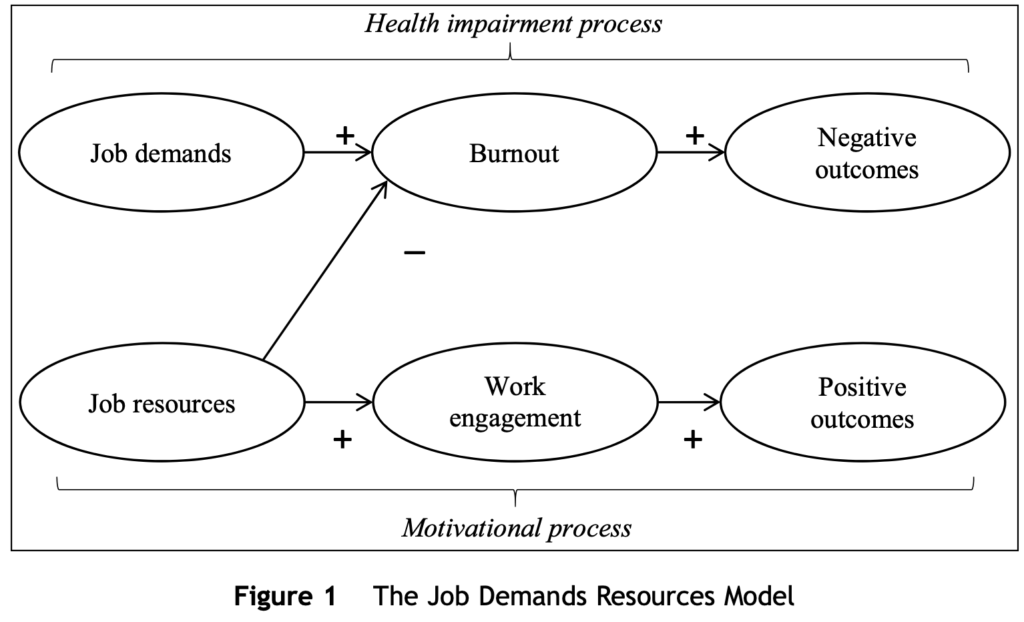
As the model above illustrates, Job Resources like colleague support, team cohesion, and coaching directly buffer against stress. In the context of onboarding, you are managing a direct “tug-of-war” between these two sides of the scale:
| Job Demands (The Drain) | Job Resources (The Support) |
|---|---|
| Systemic uncertainty and social unknowns | Explicit role clarity and written goals |
| Confusion about day-to-day responsibilities | Early, encouraging performance feedback |
| Intense information overload (long slide decks) | A dedicated buddy helping you to gain knowledge over time |
When onboarding fails for one team but succeeds for another within the same company, it is almost always a resource imbalance. The overall corporate template might be identical, but one specific manager failed to give their new hire the localized tools, support, and coaching needed to balance the scales.
A great onboarding strategy balances the equation on purpose: it deliberately lowers demands during the first few days while heavily loading resources where they matter most.
Takeaway: Before your next hire starts, look at their week-one schedule. What is one unnecessary demand you can remove or delay, and what is one concrete resource (like a buddy or a clear checklist) you can hand them on Day 1?
Using Group Cues to Build Social Identity
One of the heaviest emotional demands a new hire faces is the psychological weight of feeling like an outsider. In the language of the JD-R model, isolation is a massive drain on an employee’s energy. To balance the scale, onboarding must aggressively inject social resources. The fastest way to do that is by activating Social Identity Theory.
When a person joins a new company, their brain immediately goes to work reshaping their social identity—the way they define themselves based on the group they belong to. To do this, human beings constantly scan their new environment for subtle group cues that signal whether they are truly an insider or an outsider.
In a corporate setting, these cues exist in everyday, unwritten habits: the specific acronyms used in Slack channels, running inside jokes, unspoken meeting etiquette, and how leaders carry themselves.
A great onboarding process makes the team’s implicit habits completely explicit right away. By demystifying the team’s internal shorthand and explaining the “why” behind everyday rituals, you remove the social anxiety of decoding a new culture, allowing the new hire to confidently adopt the team’s social identity from day one.
Reinforcement and habit formation in the brain
Once the initial excitement of a new job fades, long-term routines must be built. This process is governed by the basal ganglia, the deep region of the brain responsible for taking conscious actions and turning them into automatic habits. When an employee starts a new job, their old, comfortable workplace routines are completely interrupted.
In the language of the JD-R model, forcing the brain to consciously process every single new task acts as a Job Demand. Because of this, the first few weeks naturally cause mental fatigue and behavioral resistance as the basal ganglia fights to build a new neurological routine.
Neuroscience shows that forming a lasting habit is a timeline of deliberate repetition, often taking anywhere from a few weeks to several months to firmly establish and thicken the underlying neural pathways. The basal ganglia cannot automate a routine without a consistent feedback loop: a trigger, a clear action, and an immediate reward.
Because of this neurological requirement, clear feedback and prompt praise shape behavior far more effectively than a lengthy handbook. Within your onboarding framework, these quick feedback loops serve as high-leverage Job Resources that actively lower the cognitive drain on the employee.
Tying this reinforcement to predictable weekly check-ins provides the exact rewards the basal ganglia needs to lock in consistent routines. This systematic approach carves out new neural pathways, embedding the new hire into the operational workflow until excellent performance simply becomes their default habit.

What Great Onboarding Looks Like in Practice
Before day one: Calm the predictive brain
Great onboarding removes the cognitive weight of the unknown before the start date even arrives. Provide the new hire with a concise role brief, their exact first-week schedule, key contacts, and tool access requirements. Stripping away these basis operational question marks ensures they step through the door with condidence rather than baseline anxiety.
The first day: Establish immediate belonging
Structure the first day around connection, immediate context, and a single concrete win. Keep meetings highly purposeful and brief to prevent cognitive overload. Introduce the hiring manager, an onboarding buddy, and primary teammates early in the day. Show the new hire exactly where to locate help and who owns which platforms so their brain feels grounded immediately.
The first week: Pace cognitive load
Pace all technical and cultural learning in distinct, manageable increments. Utilize short platform walkthroughs, simple checklists, and highly repeatable workflows. Build in immediate feedback loops so the new hire undergoes those critical early repetitions, effectively balancing theoretical training with real, hands-on work.
The first 30 to 90 days: Solidify habits
Gradually transition the individual from heavily guided tasks to entirely independent execution. Map this journey out using clear 30, 60, and 90-day milestones that are tied directly to real business outputs. Ensure that social support systems and manager check-ins remain tightly in place well after the first week to review skill progression and relationship building while habits solidify in the basal ganglia.
Conclusion
When a new hire struggles to get up to speed, it is often a reflection of an invisible tax we place on their brain. When we force an employee to guess at unwritten rules or drown them in data, the brain treats this confusion as an operational threat. By doing so, they enter a defensive state that freezes their ability to think clearly and drives up anxiety.
To fix this, we need to build a better structural foundation. Great onboarding balances the mental scale by reducing early friction and introducing support immediately.
- Role Clarity: Provide explicit daily goals during the first week to shut down the brain’s survival alarm.
- Cognitive Pacing: Break down technical workflows into small, manageable chunks to protect the prefrontal cortex from overload.
- Habit Formation: Pair early tasks with fast feedback to help the basal ganglia turn new routines into automatic habits.
When you remove the stress of the unknown, the brain releases the energy it needs for high-level focus and productivity. By doing so, you stop trying to find the rare employee who can survive a broken setup, and start building a stable framework where anyone can thrive.
FAQ’s
What is the behavioral psychology behind great onboarding?
At its core, onboarding is the process of helping someone make a major behavioral adjustment. Success means shifting a new hire from an “outsider” mindset—where the brain is on high alert scanning for social and structural threats—to an “insider” mindset. Once they feel like an insider, they can finally use their full mental energy to navigate your systems, platforms, and team dynamics.
How do the amygdala and prefrontal cortex interact during onboarding?
Think of the amygdala as an automatic alarm system that triggers stress when everything feels new and unpredictable. It takes about 300 milliseconds for the logical part of the brain, the prefrontal cortex, to step in and help calm that initial panic. Thoughtful onboarding builds in intentional pauses, giving the rational brain the time it needs to quiet the alarm and actually process new information.
Why does the human brain naturally resist corporate change?
Our brains are biologically hardwired to crave comfort and predictability. The routines we use at work are stored as deeply entrenched habits in the brain, often requiring dozens of repetitions to build. Starting a new job completely disrupts those automatic patterns. Without structured pacing, this sudden disruption causes a feeling of neurological discomfort that we naturally resist.
Why do small wins and feedback trigger dopamine in onboarding?
When a new hire completes a small, clear task, it gives their brain immediate proof that they are capable. Validating feedback on these small milestones triggers a dopamine loop. This positive chemical reinforcement builds the momentum and confidence they need to tackle much more complex parts of their new role later on.
How does storytelling help the brain encode culture?
Abstract corporate values on a slide deck are incredibly hard for the brain to digest. Stories, however, translate those values into real examples of human behavior. Hearing how a team handled a mistake or resolved a disagreement helps a new hire learn the actual unwritten rules of the company, bypassing the usual social anxiety of guessing how to fit in.
What should managers do in the first 30 days to support the brain’s adjustment?
Managers can ease this transition by focusing heavily on clarity and removing guesswork. Setting clear, bite-sized goals for the first month and holding regular, encouraging check-ins helps the brain build those new workplace habits. Providing a clear roadmap for their specific responsibilities gives the brain the predictability it craves to feel secure.